
Introduction
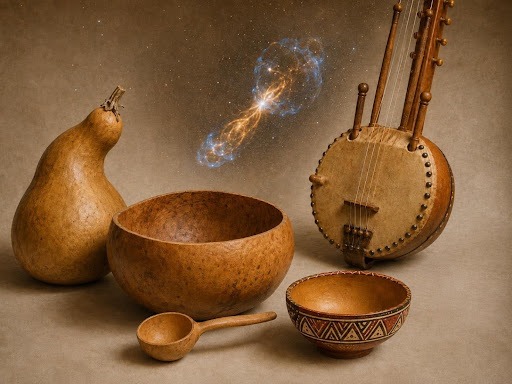
Bowl, ladle, musical instrument, decorative object and even celestial cloud, the calabash is a familiar object that hides an unsuspected richness. Present for thousands of years and found on several continents, the name actually refers to fruits produced by different plants. Let us discover this fruit with its surprisingly diverse uses.
One Name, Several Plants
The calabash we know best does not come from the calabash tree, as one might expect, but from a climbing plant in the same family as cucumbers: Lagenaria siceraria. It originated in Africa and is one of the oldest cultivated useful plants. It produces fruits known as calabashes or gourds, generally shaped like bottles or elongated fruits. The young fruits of some varieties are sometimes eaten. The calabash tree, however, belongs to a completely different family: Crescentia cujete. It originated in the Americas and produces more rounded fruits. Once the calabash shells have hardened, they are emptied and dried. They then become easy to transform.
A Wide Range of Uses in Africa
In Africa, the calabash is part of many everyday activities: drawing water, carrying or storing food and drink. Carved, engraved and sometimes painted, it also serves as a decorative object. In Burkina Faso, it remains closely associated with dolo, a traditional beer made from sorghum and usually served in a calabash. It is also used to make musical instruments, where it serves as a resonating chamber. Among percussion instruments in West Africa are the balafon, whose calabashes placed beneath the wooden bars amplify the sounds, and the shekere, a calabash covered with a beaded net. Among string instruments are the kora, made from half a calabash covered in cowhide with a wooden neck running through it, and the imzad, a single string Tuareg instrument traditionally played only by women. For some people, the calabash has strong symbolic significance associated with women, fertility and the origin of the world. In other cultures, it plays a role in ancestral rituals such as offerings to ancestors, birth ceremonies and weddings amongst others.
A Universal Traveller
The calabash does not stop at the borders of Africa. In South America, it is traditionally used to drink mate, an infusion similar to tea. In Brazil, it is used to make the berimbau, an instrument whose rhythm accompanies capoeira. In China, the gourd, known as hulu, has long been associated with luck, longevity and peace. In the Caribbean, the pulp of the calabash tree is used in traditional remedies. The calabash’s journey even extends beyond planet Earth. In 1989, a celestial object was named the Calabash Nebula because of its shape.
Conclusion
The calabash is deeply integrated into the daily lives of many Africans. However, from one continent to another, it changes in shape, function and sometimes even meaning. A Malagasy proverb compares humanity to a calabash vine: its many branches intertwine while sharing the same root. In its own way, the calabash beautifully illustrates this idea: multiple uses, diverse cultures and one shared object.
Social Media: http://www.linkedin.com/in/yoaline

Comments are closed.