
Introduction
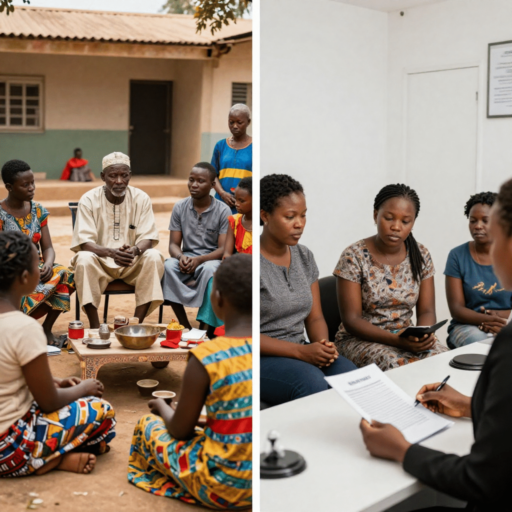
In many societies, the question of who inherits property, land, or status after a person’s death is never purely technical. It is shaped by deep cultural expectations, family structure, and evolving legal rules. In the Ugandan context, this tension is especially visible because customary practices and statutory law often clash. Understanding the clash begins with clear definitions and concrete examples. Tradition comprises unwritten customs, kinship norms, and values that guide family life and resource allocation, prioritising lineage continuity and elder authority. Inheritance transfers property, rights and status from the deceased, traditionally treating land and livestock as clan assets rather than purely individual property.
Traditional Inheritance Practices
Among the Baganda, clan elders appoint a male heir (often the eldest son) who receives the bulk of the estate and cares for widows and children; daughters may get limited land, while widows hold only user rights. The Karimojong, as pastoralists, keep livestock and residual rights in the male line; brothers or sons take over herds, and widows are commonly inherited by a male relative under levirate custom. The Iteso similarly treat land as clan property divided among sons; an heir manages the home and dependents, while women retain lifetime user rights to allocated land but do not inherit cattle or major assets. Across these systems, male heirs, clan oversight and care obligations dominate, leaving wives and daughters with restricted independent rights.
Modern Law and Equality
Modern law, rooted in the 1906 Succession Ordinance and reformed by the 2022 Amendment (now Cap. 268), prioritises equality under the 1995 Constitution. A will is permitted with protections for spouses and children. On intestacy, shares typically allocate about 20% to the surviving spouse(s), 75% equally to all lineal descendants regardless of gender, 4% to dependent relatives and 1% to the customary heir. Courts administer estates, and any custom conflicting with constitutional equality is invalid.
Conclusion
The question “Who should inherit?” therefore has no single answer. It depends on whether one privileges the long-term survival of the lineage, the equal treatment of all children, the security of a surviving spouse, or some workable blend of both. Uganda’s current law attempts the blend of equal shares for lineal descendants, a symbolic place for the customary heir, and constitutional guardrails against discrimination. How successfully that blend works in villages and courtrooms across the country remains one of the central challenges of family law in contemporary Uganda.

Comments are closed.