
Introduction
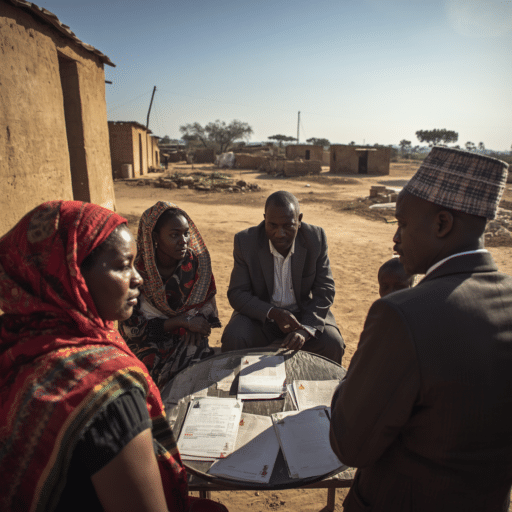
How does a person become invisible? Not physically. Not socially. Legally. Across the Sahel, thousands of people wake up every day without what many of us take for granted: proof that they belong anywhere. They have families, communities, histories, languages, and homes, yet without a birth certificate, a national identity card or proof of nationality, they often find themselves locked out of the very rights that are supposed to belong to all human beings.
This is the paradox of statelessness. The Universal Declaration of Human Rights claims that everyone has the right to a nationality, yet in practice the rights are often accessible to those who can prove their existence on paper. The result is a troubling reality that a person’s humanity may be universal, but legal recognition is conditional. In the Sahel, where conflict, displacement, porous borders, and weak civil registration systems intersect, statelessness is more than an administrative challenge it is instead a question of dignity. An even deeper question lies beneath it: Why are the people of the Sahel required to fit into citizenship models that were never designed around their realities in the first place?
Historical Identities and Modern Borders
Long before colonial borders, communities such as the Tuareg, Fulani and Toubou moved across the vast territories through trade, pastoralism and kinship networks. Now imagine the irony of people whose ancestors traversed the Sahel freely for centuries are told they do not belong because they cannot prove a connection to a state that is younger than their own communities. This even opens a more uncomfortable question: Is statelessness really a failure of individuals to prove citizenship or a failure of modern states to accommodate African identities and understanding realities.
The Consequences of Legal Exclusion
The consequences of exclusion are not abstract. Without legal identity, people are cut off from education, healthcare, political participation, amongst many other rights that are meant to be inherent yet are now conditional on recognition. Statelessness therefore does not only deny citizenship but produces invisibility and it is rarely neutral. It shapes who is accounted for in national statistics, prioritised in policy and who remains outside systems of care and protection. Citizenship is often treated as a technical legal status but in practice functions as a gatekeeping mechanism belonging to itself by deciding who is protected or left exposed.
Colonial Legacies and the Question of Belonging
Frantz Fanon’s broader work on colonial systems of classification befits this tension as colonial and postcolonial systems often decide whose identities are legible and whose are not. From this viewpoint, statelessness is not only about missing documents but about systems that determine who counts in the first place. When identity becomes something granted rather than lived reality, we are left with a final question that does not have an easy answer: if communities belong in every meaningful way except legal, then who is citizenship really for and who actually gets to decide?
Conclusion
Statelessness in the Sahel demands a rethink of citizenship and belonging. Everyone deserves fundamental rights, regardless of documentation. True inclusion requires states to recognise diverse identities and histories, ensuring everyone can participate, belong and live with dignity.
Social Media: https://www.facebook.com/share/1BqFatyDGv/?mibextid=wwXIfr

Comments are closed.