
Introduction
Your heart starts racing. Your breathing becomes short. Your hands tremble. A thought suddenly comes to mind: “Something serious is happening to me.” These are some of the signs of an anxiety attack, also known as a panic attack. It can be very frightening. Yet, learning to recognise what is happening can already help you regain a sense of control. Understanding the attack, knowing a few simple techniques and knowing when to seek help can change the way you experience it.
When the Alarm Goes Off Without a Fire
When faced with danger, our body reacts. After assessing the situation, it quickly prepares to fight or flee. The heart beats faster and harder, breathing changes, muscles tense and alertness increases. This cascade of reactions is triggered by our alarm system. During a panic attack, two mechanisms can follow one another. First, the system may react with great intensity even though there is no immediate real danger. It acts like a fire alarm that starts ringing and triggers a general mobilisation to put out a fire that does not exist. Second, the sensations themselves become frightening. They are interpreted as danger, increasing fear and further activating the alarm. A vicious cycle is then established.
One Attack, Many Faces
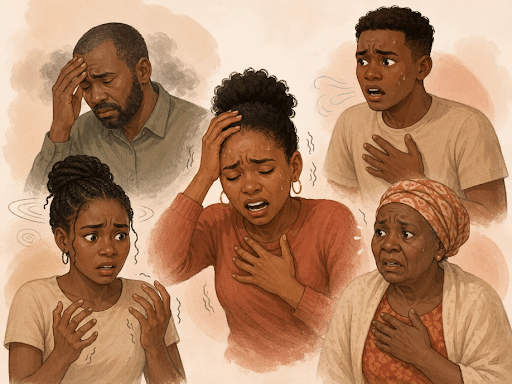
Panic attacks can occur at different ages and affect both men and women. Their manifestations are as varied as the factors that may contribute to or trigger them. Symptoms differ from one person to another, but they always combine unpleasant physical sensations with intense psychological distress. For example, one person may experience a tight throat and dizziness during an attack, while another may experience trembling, difficulty breathing or chest pain. A panic attack can also alter the way we perceive our surroundings. Some people may feel disconnected from reality or as though they have lost control of their bodies. These sensations may be accompanied by intense thoughts, such as the fear of dying or losing one’s mind. This diversity explains why panic attacks can be difficult to recognise, especially when they occur for the first time. However, one important rule should always be kept in mind: not every physical symptom is necessarily related to anxiety. For example, an inability to move a limb or persistent, severe chest pain should be taken seriously. In such cases, contact the emergency medical services or go to the nearest health centre. A first attack, unusual symptoms or worrying signs should also lead to seeking medical advice.
Breaking the Cycle and Building Your Toolkit
When an attack intensifies, the goal is not to fight the sensations with all your strength. Rather, it is to gradually help the body and attention return to the present moment and become grounded in it. A few simple techniques can be tried: sit down and place your feet firmly on the ground, name what is happening, gently slow your breathing, breathe out for longer than you breathe in without forcing it, and use your senses to reconnect with your surroundings. There are several techniques for doing this, and their effectiveness may vary from one person to another. Trying them in advance makes it possible to identify those with which you feel most comfortable and to use them more easily when an attack occurs. It is in this spirit that tools such as the Carnet de Sérénité were developed. Over seven days, it encourages people to experiment with different techniques, observe their effects and gradually build their own personal toolkit. The goal is not to control everything, but to better understand yourself and have useful reference points when anxiety rises.
Conclusion
A panic attack can create the feeling that everything is slipping out of control. It can sometimes feel like an emotional storm: overwhelming at first, but less confusing once it is recognised and understood. There is no universal tool. The essential thing is to learn which techniques work best for you. However, when attacks become frequent, very intense or interfere with daily life, do not hesitate to seek help from a healthcare professional.
Social Media: http://www.linkedin.com/in/yoaline

Comments are closed.