
Introduction
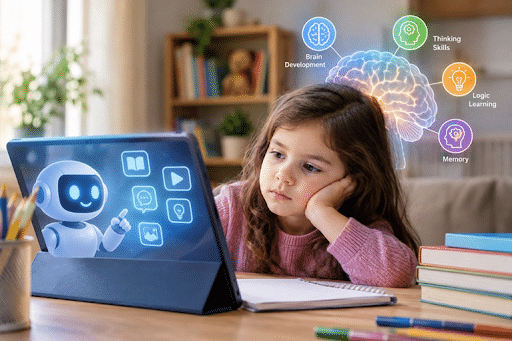
Artificial intelligence has a growing role in the classroom: explaining ideas, developing activities, and answering questions. But when we rely on artificial intelligence to be the sole source of a child’s education, especially in the early years, we risk losing something valuable: the opportunity for children to think, question, remember, imagine, and problem-solve.
A Child’s Brain Needs to Work Things Out for Itself
At a young age, children need to explore and actively participate in their world. They need the experience of working through challenges. The process of grappling with a difficult question or puzzle is how they develop thinking skills, like reasoning, deduction, and logic. Giving a child an answer or completing a task for them might give them an immediate sense of accomplishment, but they miss out on the thinking process that leads to real mastery and critical thinking.
Artificial Intelligence can Rob Young Children of Curiosity and Creativity
Children are naturally curious. A child’s imagination can lead them to unexpected places but only if we let them. Their questions and the ideas that come from them are an important part of early childhood development. But when we allow AI to answer those questions or complete those tasks, we lose their curiosity and creativity to a sense of entitlement. Their brains can become accustomed to seeking not an answer or solution but the most convenient answer or solution. The child’s own initiative, imagination, and independence are replaced by a reliance on the AI to know what to do next.
A Child’s Education should be a Social Experience, not a Solitary One
Children learn a lot through play, but play is a social act. From a very early age, children develop language, reasoning, and social skills through interactions with other people. Even infants can learn new concepts through imitative play. But AI can’t replace the social interaction that comes with human play. A child’s conversations with teachers, parents, and peers help them build concepts and challenge their thinking in ways that a machine cannot. Even though a computer can recognize a child’s question, it can’t have a conversation with them. A human can better guide a child through the process of figuring something out for themselves. Technology can support early childhood education, but it can’t be an effective substitute for human interaction and social learning.
Conclusion
Technology has a place in education, but it should be a tool to aid students, not a replacement for teachers. Artificial intelligence can support early childhood education, but when it comes to the youngest learners, it shouldn’t be the primary source of instruction. Children need to learn for themselves and through their own exploration, using their own brains, bodies, and voices. But with the right tools, technology can be used to help parents and teachers provide a rich and varied educational experience.
Social Media: https://www.facebook.com/mennatallah.sayed.835237

Comments are closed.