
Introduction
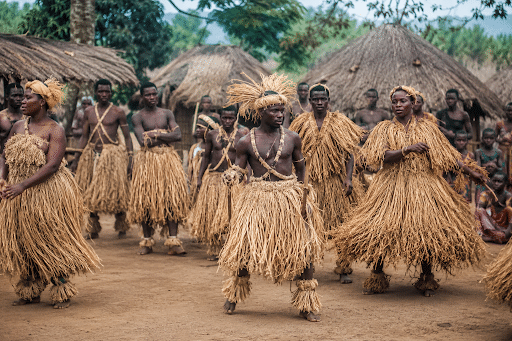
Long told around the fire, the history of the Boa people, also known as the Baboa, remains one of the most fascinating aspects of Congolese cultural heritage. Although several aspects of their origins continue to fuel debates among historians and custodians of oral tradition, there is general agreement that the Boa people have an ancient heritage shaped by long migrations, alliances and transformations that have forged their present-day identity. Their history reflects the richness of traditions and population movements in Central Africa.
Founding Narratives: A Shared Ancestry
Early European ethnographers, particularly J. Halkin, identify Abamake as the founding ancestor of the Boa people. According to this account, he had two sons: Bati, the eldest, and Yeu, the youngest, from whom the two main branches of the ethnic group originated. Another tradition, documented by A. Dereine, traces their origins further back, describing Abamake as the first man created by Kundji, a mythical figure associated with the deity Engali. This account also identifies Abamake as the ancestor of neighbouring peoples, including the Zande, Barambo and Bakere, although this theory has yet to be definitively established.
A Shared Linguistic and Cultural Identity
Despite these differences, the Boa people remain united by a common cultural and linguistic identity. The descendants of Bati speak Lebati, while those of Yeu speak Leboale. These two varieties belong to the same language and reflect a shared history spanning several centuries. Lebati speakers include the Apagibete, Bagolo, Babenge, Babati and Bagbe. Leboale, on the other hand, is spoken notably by the Bayeu, Baboa, Bangengeta, Balisi, Bokiba, Bonganzolo and Bawenza. This linguistic diversity reflects the different branches of a shared heritage and contributes to the preservation of Boa collective memory.
A People on the Move: Migrations and Present-Day Settlements
According to oral traditions, the ancestors of the Boa left regions south of Egypt or Nubia before embarking on a long migration through Cameroon, the Central African Republic and northern Ubangi. They eventually settled on both sides of the Uele River. Their journey is said to have involved conflicts, particularly with the Zande, leading to their dispersal across several regions of what is now northern Democratic Republic of the Congo. Today, the Boa people are mainly settled in the provinces of Bas-Uele, Tshopo, Mongala and Nord-Ubangi. Several related communities, including the Pagabete, Bira and some Babudu groups, also claim Boa ancestry or retain linguistic elements inherited from this shared history.
Conclusion
The history of the Boa people is more than an account of a distant past. It is a living memory that sheds light on the migrations of Central African peoples and reminds us that a community’s identity is shaped both by its roots and by its commitment to preserving them. Passing this history on means contributing to the protection of a valuable cultural and linguistic heritage for future generations.

Comments are closed.