
Introduction
Although play is often seen as a form of entertainment, it is also a way for children to understand the world, experiment and develop their abilities. Through play, children learn to observe, think, cooperate and solve problems. Play is therefore a serious activity, even when it appears spontaneous. Children already learn a great deal through play, whether at home, in the playground or at school. This shows that learning does not only happen through books or formal lessons. It can also develop through action, imitation and experience.
What Play Develops in Children
Play develops several skills at the same time. It stimulates memory, concentration and creativity. It also helps children improve their motor skills, wait their turn and manage their emotions. When children play with others, they learn to share, listen and respect rules. They also discover how to cope with losing without becoming discouraged and how to try again after making a mistake. These experiences are valuable for their academic and social development. Play also strengthens self-confidence. When children succeed in a playful activity, they feel capable and empowered. They learn that they can test ideas, make choices and find solutions.
The Role of School and Home
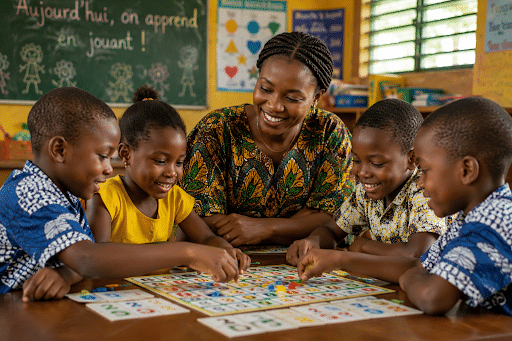
Play can be used everywhere. At home, it helps parents create opportunities for interaction and learning. At school, it makes lessons more engaging and accessible. Children often remember a concept better when they have handled it, acted it out or put it into practice. Teachers can incorporate play into mathematics, reading, languages and science. Parents can also introduce simple games that develop reasoning, language or motor skills. The key is to make play a learning tool rather than simply a distraction. Not all games serve the same purpose. To become an effective learning tool, a playful activity must be adapted to the child’s age and to the knowledge or skill being targeted.
A Method Suitable for All Ages
Play is not limited to young children. It remains useful at different stages of childhood and even beyond. Younger children learn through objects, sounds and movements, while older children benefit more from role-playing, challenges, construction activities and group games. This flexibility explains why play is so powerful. It can be adapted to each child’s age, level and pace, while also taking into account differences among learners.
Conclusion
Academic success is often associated with performance and repetition, but play reminds us of another important truth: children learn better when they are active, curious and engaged. Enjoyment can therefore be a gateway to knowledge.
Social Media: https://www.facebook.com/share/187WaugKDz/

Comments are closed.