
Introduction
The human lifecycle is a sequential progression starting from critical period infancy advancing to childhood ending up with mature adulthood. The childhood stage is the bridge to productive adulthood that should be in a nurturing and supportive developmental track. As the WHO outlined, the child development concept as a multidimensional dynamic process of gradual skill learning in different domains involving progression from dependence on parents towards greater independence during adolescence.
Physiological Growth
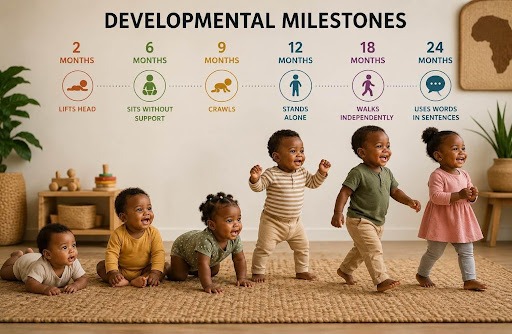
The youngster developmental trajectory includes four major pillars gross motor “big body movements”, fine motor “hand and finger skills”, language and communication, and social-emotional which are monitored in accordance with age. At around 2 months, infants begin to lift their head, open their hands, make sounds and smile in response to people. At 6 months, babies can roll, sit with support, grasp objects, respond to their name and recognize familiar people. At 9 months, they crawl finally, pick up food, bubbles and show strange anxiety. By 12 months, they can stand, use a pincer grasp, say ‘mama’ and wave goodbye. By 18 months, kids can walk and run, use a spoon with assistance, say several words and begin simple pretend play. At 2 years, toddlers can walk upstairs, build a tower, say two-word phrases and play alongside other children. At 3 years, they can pedal a tricycle, draw a circle, tell simple stories, and engage in imaginative play. By 4 years, children often hop, draw a person, tell long stories, and participate in pretend play. By 5 years, children develop advanced coordination activities; their fine motor skills allow them to write some letters, their language becomes more complex, and socially they are cooperative. Awareness of this informative guidance will help in pointing out early developmental delays “red flags” by parents to give the child the best opportunity to reach their full potential.
Red Flags
The age-proportionate developmental milestones are not strict deadlines as each child may reach individual milestones a little earlier or later. The warning signs of child development are either in the form of progression in which there is no or very slow progress or regression where there is a loss of previously acquired skills at any age. Those indicators are simplified into a traffic light approach clarifying when and how to act. Green means your child is meeting appropriate age milestones and learning new skills, such as making eye contact and babbling in infancy, speaking in words and walking by age 2, playing with others and doing well in school. In the green zone, parents should feel reassured and continue supporting growth. Yellow means to watch and check in. This applies if a child is slightly delayed in one area but still progressing, for example saying only a few words by 18 months or needing more time to learn new tasks. In this case, parents should mention it to their pediatrician at the next visit and increase interaction, play, and practice at home. Red means to reach out to a doctor now. This includes missing major milestones like no eye contact by 3 months, no words by 16 months, no walking by 18 months, no sentences by 3 years or losing skills the child once had. In the red zone, parents should book an appointment with their child development specialist right away. The flags identification is imperative to prevent bigger challenges later, improve communication with caregivers, and empower every parent.
Familial Healthy Development
Parents are the first observers for their children, requiring knowledge, connection, and confidence as reported recently, that 1in 6 children have a developmental delay. Parents’ monitoring becomes an obligatory task towards the future generation monitoring should aim for effective support without waiting for red flags in other words “preventive support” using the four developmental dimensions. For gross motor skills, give your child time and space to move. Tummy time, crawling, and outdoor play help build strength and coordination. For fine motor skills, encourage hands-on play like stacking blocks, drawing, feeding themselves, and doing small tasks like buttoning. For language and communication, talk with your child throughout the day, sing songs and rhymes, and respond to their sounds. The more you talk and listen, the stronger their vocabulary becomes. For social and emotional skills, make eye contact, play face-to-face, name their feelings, and give them chances to play. These daily moments of connection teach them how to build relationships. This framework will answer crucial questions ‘Is my child on track?’ and ‘Am I doing enough?”
Conclusion
Natural and steady child development ensures long-term health, strong foundations for learning and connecting and a stress-free life. Healthy milestones can be achieved under their parents’ supervision as pediatricians globally send a straightforward message: “You are your child’s first teacher. The love, play and attention you give directly shape their development”.

Comments are closed.