
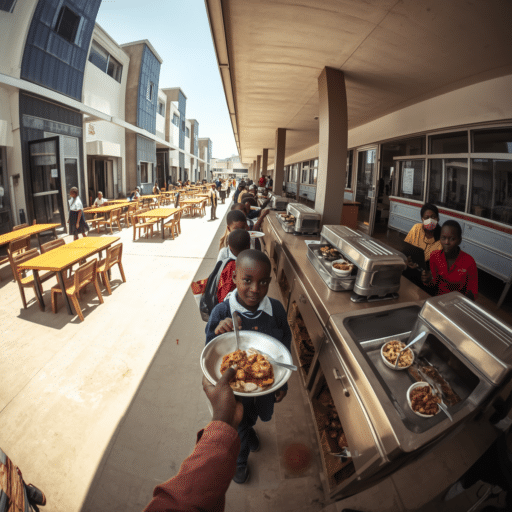
Introduction
School feeding programs exist across much of sub-Saharan Africa with a clear and urgent purpose: to keep hungry children in school, improve their concentration, and give families one less reason to keep children at home. The intention is sound. The implementation, in too many countries, is not. What should be a basic safety net for vulnerable learners has become a system riddled with inconsistency, mismanagement, and in some cases outright corruption, leaving the children it was designed to serve with irregular meals, poor nutrition, or nothing at all.
Underfunded and Overpromised
Across Africa, school feeding programs are chronically underfunded relative to the populations they are meant to serve. Per-child daily allocations in several countries are so low that the meals produced barely qualify as nutritious. Porridge with no protein, plain rice with no vegetables, or simply a piece of bread, these are not meals that sustain learning. They are political gestures dressed as nutrition policy. Governments announce the programs at launch and then quietly fail to maintain the funding levels required to run them properly.
Supply chains present a separate problem. Food deliveries to rural schools are frequently delayed, reduced, or simply do not arrive. Teachers are sometimes expected to manage food preparation on top of their teaching responsibilities, with no additional support or compensation. In poorly resourced schools, cooking facilities are inadequate, storage is nonexistent, and the food that does arrive spoils before it can be used.
Where the Money Actually Goes
School feeding funds have, in multiple documented cases across West, East, and Southern Africa, been diverted before reaching the children. Procurement processes are manipulated to favour connected suppliers who deliver inferior or reduced quantities. Funds allocated per learner are skimmed at various points in the administrative chain. The children who were hungry when the program was announced remain hungry years later, while auditors produce reports that rarely lead to consequences.
The families of affected children often have no mechanism to report these failures or hold anyone accountable. Rural school communities in particular lack the voice and the access to institutions that might investigate or intervene. The dysfunction continues because those experiencing it have the least power to stop it.
Nutrition Is Not Optional in Education
A hungry child cannot concentrate, retain information, or engage meaningfully with learning. The research on this is consistent and long-established. School feeding programs, when properly funded and honestly administered, improve attendance, reduce dropout rates, and produce measurable gains in academic performance. The programs work when they are actually run.
Conclusion
Africa does not have a school feeding program problem. It has an accountability and execution problem. Fixing it requires transparent procurement, community oversight of food delivery, and genuine consequences for those who treat children’s meals as a source of personal income. The children in those classrooms are not a budget line. They are the future these programs claim to be investing in.
Social Media: https://www.facebook.com/ApolloGuile

Comments are closed.