
Introduction
Africa faces growing challenges in terms of water security. Water-intensive industries, desertification, urbanisation, water pollution, and climate change threaten both the supply and access to clean water. Despite this, Africa has a wealth of water resources, though with highly varying levels of freshwater availability.
Alternative Water Source
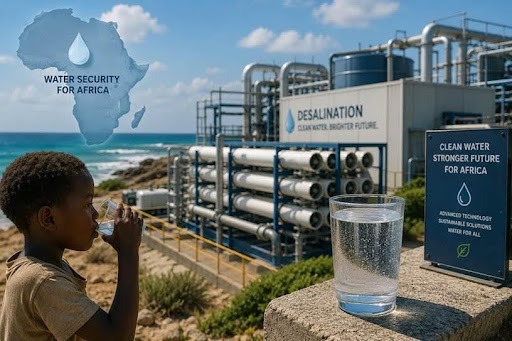
The problem is worsened by the fact that coastal countries possess an alternate resource: seawater. With the rise in purification and desalination technologies, seawater can be processed to generate a steady supply of freshwater. The technology thus has the potential to be a part of Africa’s sustainable water security strategy.
A Multifaceted Approach
Water issues in Africa are not only about scarcity but also about access to existing resources, treatment capacity, and urbanisation. Many local populations are highly reliant on local freshwater sources, which are threatened by both desertification and pollution. At the same time, urbanisation puts an ever-growing strain on water supplies and distribution infrastructure. With changing weather patterns and increasingly unpredictable monsoon seasons, it is likely that many countries and territories will have to resort to a more diversified approach to water security, relying less on local freshwater resources. Thus, diversifying sources and preparing infrastructure to deal with water shortages and threats to quality are the primary concerns of many African states.
Seawater as an Additional Valuable Source of Water
Many African states are highly reliant on local water sources, which are threatened by climate change. Seawater desalination can be a great solution for some African states, particularly those at risk of or already undergoing desertification and water scarcity. Seawater desalination using advanced methods such as reverse osmosis can generate freshwater suitable for drinking and industrial use.
Advanced Desalination Technology
Moreover, advances in membrane technology, automation, and energy recovery have made desalination a viable technology to consider. Given the high energy demands of the process, optimisation is key, which is why the sector needs to invest in renewable energy sources (particularly solar) and innovations.
Concerns about Technical Advanced Desalination Methods
While the technology has great potential, it is not a silver bullet, for there are several sustainability concerns regarding desalination and seawater use. While seawater desalination can serve as an excellent source of freshwater, it should not be the primary one. Freshwater resources should be prioritized for domestic and municipal use.
Optimizing Desalination Process
Desalination plants can be extremely energy-intensive, which makes their economic and environmental viability questionable. Moreover, brine discharge, operational maintenance, and water transport can put additional strain on the local environment. Thus, to make desalination a sustainable solution, it has to be complemented by other methods such as wastewater recycling and freshwater conservation initiatives. Additionally, optimising desalination processes and adopting renewable energy sources such as solar energy can reduce the environmental impact while making the technology economically viable.
Conclusion
Africa must diversify its water sources and invest in advanced water treatment technologies to ensure long-term sustainability and security. The technology itself is not without challenges, particularly in terms of environmental impact. However, when used in tandem with other methods, desalination can provide a steady supply of freshwater to populations and municipalities in need.
Social Media: https://www.facebook.com/share/1Guhbc72Ki/

Comments are closed.